

4.9/5Loved by 90K+ designers, freelancers & agencies

Convert Your fig2wp figma icons ucwr figma mark Figma Design Into
ucwr wordpress v7 WordPress With Full Pixel Control

You decide how each layer becomes a widget, block, or element, down to the pixel, in all three builders.

Get StartedNo credit card requiredDownload the plugin
You Map Every LayerPixel-Level PrecisionNative, Editable WidgetsElementor, Gutenberg, BricksGlobal SyncYou Map Every LayerPixel-Level PrecisionNative, Editable WidgetsElementor, Gutenberg, BricksGlobal Sync
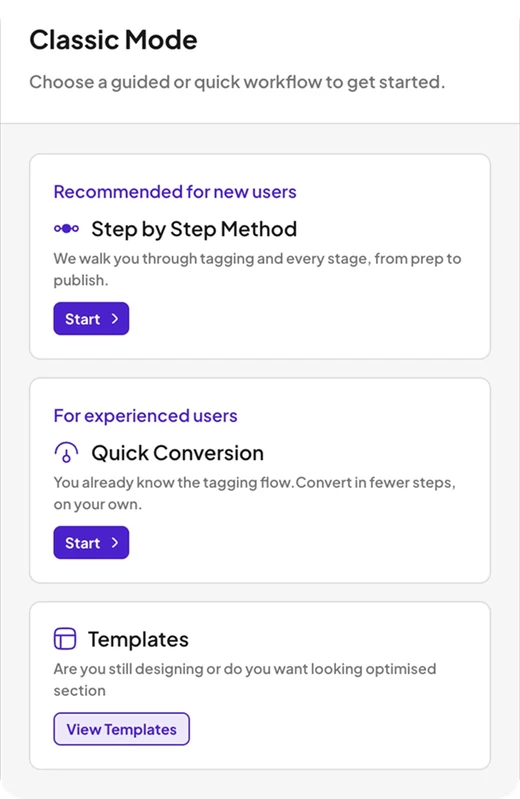
UiChemy Classic Mode walkthrough
The classic pixel-control workflow

Control Every Step From Figma To
Live WordPress

1

Start With Your Approved Design

Choose the Figma frame you want on the page.

2

Prep Layers And Compress Media

Handle media your way, automatic or by hand.

3

Widget Tagging And Auto Layout

Map each layer to a widget, block, or element, then set auto layout and responsive behavior across breakpoints.

4

Connect Your Site, Sync Globals

Link your WordPress site and bring your global color, type, and spacing across.*

5

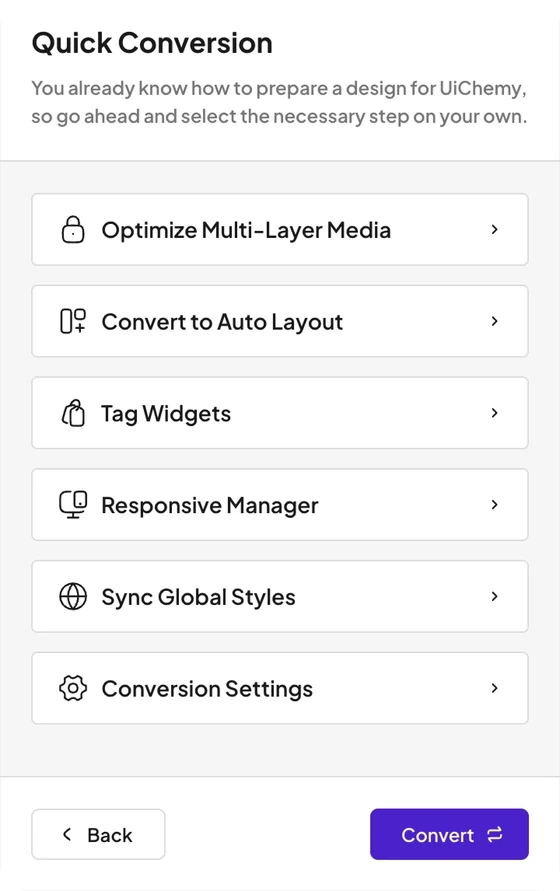
Check Your Settings, Then Convert

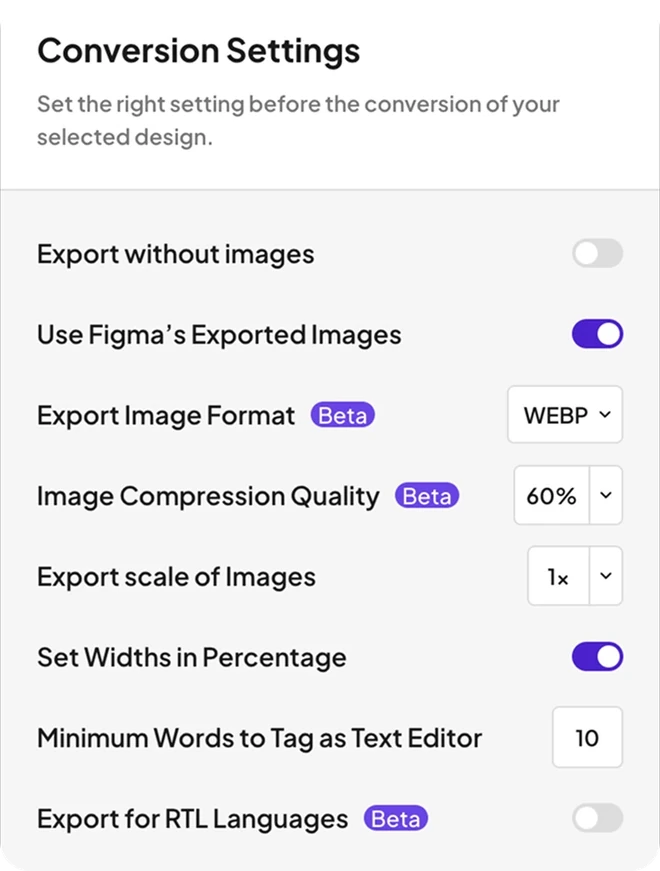
Check your conversion settings, then run the convert.

6

Preview The Page, Then Publish

Open the live page and check it before it goes public.

1

Start With Your Approved Design

Choose the Figma frame you want on the page.

2

Prep Layers And Compress Media

Handle media your way, automatic or by hand.

3

Widget Tagging And Auto Layout

Map each layer to a widget, block, or element, then set auto layout and responsive behavior across breakpoints.

4

Connect Your Site, Sync Globals

Link your WordPress site and bring your global color, type, and spacing across.*

5

Check Your Settings, Then Convert

Check your conversion settings, then run the convert.

6

Preview The Page, Then Publish

Open the live page and check it before it goes public.

* Global sync covers Elementor and Bricks today. Gutenberg support is coming.

Native to Elementor, Bricks, and Gutenberg

Native Widgets And Blocks Your Team Can Actually Edit

Clean, editable output across Elementor v3 and v4, Bricks, and Gutenberg blocks like Nexter and GenerateBlocks, never a flat HTML dump.

ucwr elementor classic v2

Elementor (Classic)

Converts your Figma designs into fully customizable, editable Elementor websites on the classic v3 engine.

ucwr elementor v4 atomic v2

Elementor v4 (Atomic)

Builds structured sites with Elementor's Atomic elements and class-based styling, powered by your Figma design system.

Also available

Or Convert Into Elementor V4 Atomic

Same Figma frame, a different output. Classic Mode is not going anywhere. In V4 your styles simply become reusable classes rather than settings on each element.
ucwr classic 3 r3ucwr classic 2 r3UiChemy plugin with Editor V4 widgets
Live now

Elementor V4 Atomic: styles become classes

Your Figma styles convert into reusable Elementor classes instead of settings buried on each element. Structured, responsive, still fully editable.

Explore Elementor V4 Atomic
Everything UiChemy does

Everything You Need To Finish The Build Lives In One Plugin

29 tools in one install, with no add-ons to chase. Pick a category to explore the toolkit for turning Figma into editable WordPress.

All new step-by-step guided flow

A guided flow carries every design detail across, from colors and type to container widths.

Express and Optimize convert mode

Convert fast with Express, or refine step by step with the guided optimizer.

Lock multi-layer vectors

Lock and optimize complex vectors so your designs stay fast and light.

Smart image compression

Export in PNG, JPEG, AVIF, or WEBP with quality control for lighter files.

Optimize Relume designs

Optimize Relume layouts for a clean WordPress conversion.

Figma Auto Layout 4.0 compatibility

Figma Auto Layout 4.0 support keeps responsive structure intact.

Tag widgets for best conversion

Tag design elements to page builder widgets for accurate, fully editable output.

Responsive across devices

Looks great on any device with responsive conversion.

Auto fetch design values

Auto-detect font sizes, padding, line height, and flex gap from your Figma file.

Global color sync

Sync Figma colors into your builder's global colors. (Coming soon to Gutenberg)

Global typography sync

Sync Figma text styles into global typography. (Coming soon to Gutenberg)

Global padding sync

Sync padding values from Figma for consistent spacing. (Bricks only)

Global boxed width container sync

Keep layouts consistent with a global container width.

Flexible conversion settings

Control image export, scale, SVGs, and responsive widths.

Multiple page builder support

Convert for Elementor, Bricks, and Gutenberg.

Direct import to WordPress

Send designs straight to your WordPress site, no manual uploads.

Copy and paste to Elementor

Copy a section in Figma and paste it straight into Elementor.

Copy and paste to Gutenberg

Copy a section in Figma and paste it straight into Gutenberg.

Copy and paste to Bricks

Copy a section in Figma and paste it straight into Bricks.

Section replacement and addition

Replace or add sections without touching the rest of your page.

Header and footer template export

Export headers and footers as reusable templates.

SEO-friendly export generation

Clean, SEO-friendly output with well-structured, semantic markup.

Flexible page publishing options

Publish as different page types or templates.

Import multiple pages at batch

Export multiple Figma pages to WordPress in one batch.

Choose your import method

Bring your design into WordPress your way: direct import, or copy and paste into your editor.

Manual design import with JSON

Import designs manually with JSON for flexibility and precision.

Multi-domain site connectivity

Connect and manage multiple domain sites from one plugin.

Automatic prep or full manual control

Fine-Tune Every Layer Before You Convert

Optimization readies your Figma file for an accurate conversion, so the output lands clean and predictable with no rework after export. Let UiChemy handle it automatically, or take manual control over auto layout, hierarchy, and media.

Auto

Auto optimization

One action prepares your design for a clean conversion. UiChemy scans the frame, fixes common issues, and gets it conversion-ready so you can move straight to export.

Best when you want speed and a design that is already close to conversion-ready.

Manual

Manual optimization

Step through each stage yourself and learn the standards as you go: how to structure with auto layout, keep a clean hierarchy, and prepare media the right way.

  1. 01Media & vectors
  2. 02Layer cleanup & improvements
  3. 03Shape cleanup
  4. 04Frames & groups cleanup
  5. 05Text & divider cleanup
  6. 06Auto layout

Stroked Vectors & Shapes

Vector, rectangle, ellipse, star, or line with a visible stroke. Outlines the stroke to filled paths; shapes with both fill and stroke are flattened into one vector.

Flattenable Vector Groups

Group or frame containing only vector shapes. Flatten into a single vector to simplify the layer tree.

Unlocked Image & Icon Layers

Unlocked asset layers can't be identified as a single export unit.

Clipped Nodes Outside Bounds

Fully clipped nodes. Invisible in output, adds file bloat.

Invisible or Hidden Layers

Hidden or zero-opacity layers with no visual contribution.

Incorrect Layer Constraints

Constraints will break the layout when the frame is resized.

Vectors Used as Rectangles

A plain rectangular vector. A native Rectangle is lighter.

Groups With Rectangle Background

Group uses a background rectangle and child layers. Convert to a Frame container.

Rectangles Containing Siblings

Rectangle is used as a container with sibling layers. Convert to a Frame container.

Ellipses Used as Containers

Ellipse used as a container. Convert to a rounded Frame.

Redundant Wrapper Layers

Single-child wrapper adds depth with no structural benefit.

Groups Instead of Frames

Groups lack auto layout and constraints. Use a Frame instead.

Duplicate Nested Frames

Identical-size nested frame with no visual purpose.

Nodes Covered by Overlapping Layers

Solid layer on top hides all siblings. Serves no purpose.

Absolutely Positioned Orphan Nodes

Node is outside its logical parent. Breaks responsive output.

Masks Used as Backgrounds

Mask simulates a fill. Use a proper frame background instead.

Oversized Line Heights Detected

Line height over 160%. Use parent spacing instead.

Line Nodes Used as Dividers

Line node used as a stroke. Remove it and apply as a proper stroke.

Frames Without Auto Layout

Frame has no auto layout. Children need to be wrapped in auto layout for proper responsive output.

Leftover Frames After Auto Layout

Leftover wrapper frame after conversion. Safe to remove.

Negative Auto Layout Gap

Negative gap causes children to overlap unexpectedly.

Layer-to-widget mapping you control

Map Any Layer To The Native Widget You Want

Assign any layer to the exact widget it should become, so the page arrives fully editable and matches your design down to the element.


Figma designLive WordPressLive WordPress pageFigma design

Drag the handle to compare

Hand-coding vs UiChemy, timed

Same Pixel-Perfect Result, A Fraction Of The Time

From an approved Figma design to a live WordPress page, watch the hours stack up building by hand against the same build with UiChemy.

Without UiChemy0h
With UiChemy (Classic)0h
Live
30 to 60h

Without UiChemy

Rebuild every section by hand in WordPress from the Figma design10 to 20h
Match spacing, styles & typography by eye5 to 10h
Add every image & all content manually3 to 6h
Set responsiveness across every breakpoint5 to 10h
Make it functional & interactive4 to 8h
Add motion & on-load animation3 to 6h
7 to 11h

With UiChemy

Prepare design with pre-made templates & wireframes2 to 3h
Verify with manager1h
Optimize & tag with the right widgets1 to 2h
Import everything at once: global colors, text & images*Handled for you
Improve the design & touch-ups1 to 2h
Final QA & submit1 to 2h
0 to 0 hours saved

Roughly 80% to 90% less time on every build. The tedious hours, gone.

Watch and learn

See Real Figma Files Become WordPress Pages

Real walkthroughs and reviews from the UiChemy channel and the community.

UiChemy full walkthrough: Figma to WordPress
Like what you see?Subscribe on YouTube
Figma templates

1,300+ Figma Templates And Sections, Built For UiChemy

Start from a design that is already optimized for a clean conversion. Sprout UI is a free Figma web UI kit and design system, ready to convert.
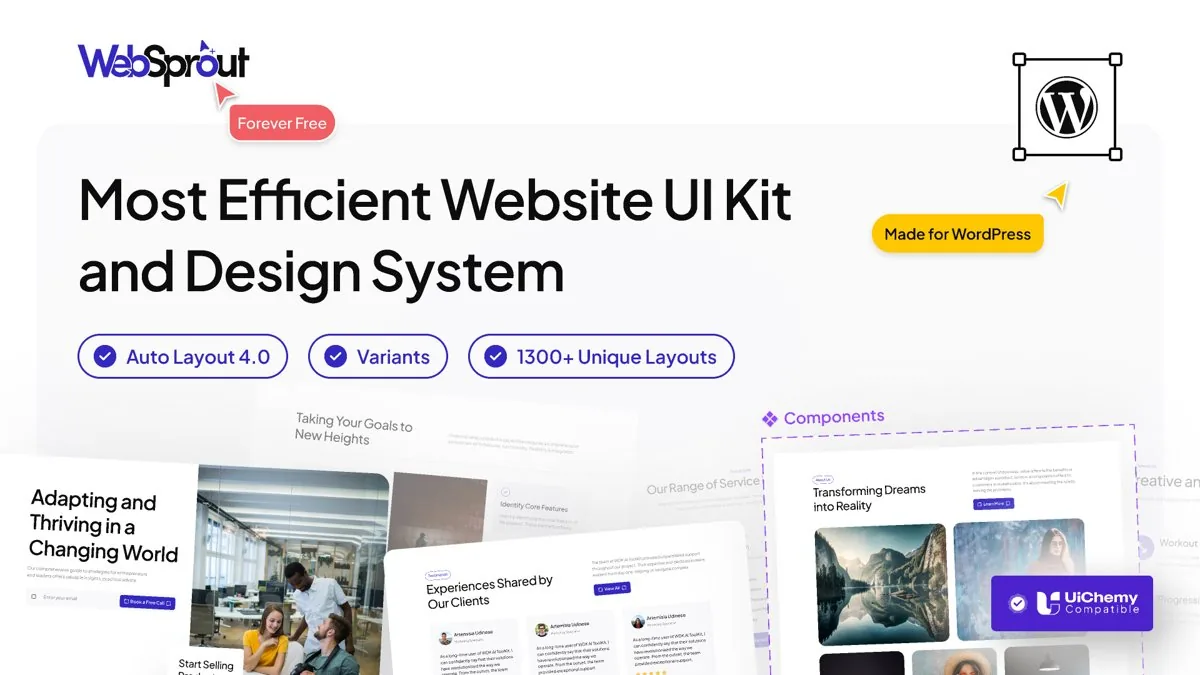
Sprout UI, a free Figma web UI kit and design system
Free Figma files

11 Production-Ready Designs, Pre-Tagged For You

Published free on the Figma community: built with auto layout, a clean hierarchy, global variables and styles, fully responsive, and already tagged with Elementor free and pro widgets.


Pre-taggedEV Voltedge

EV Voltedge

EV and automotive landing page

View on Figma
Pre-taggedCleanGenix

CleanGenix

Cleaning services landing page

View on Figma
Pre-taggedNestora

Nestora

Real estate property listing

View on Figma
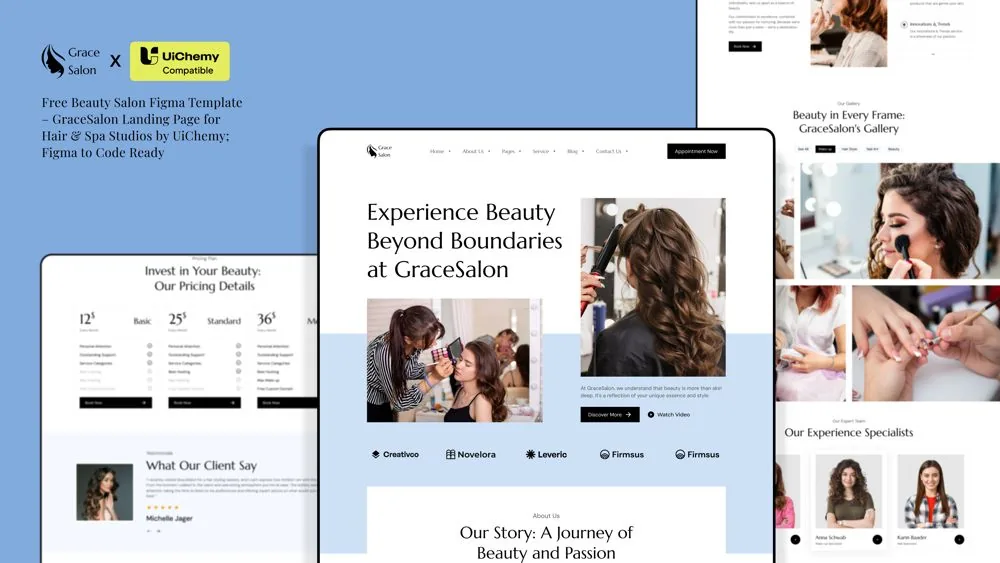
Pre-taggedGraceSalon

GraceSalon

Beauty salon landing page

View on Figma
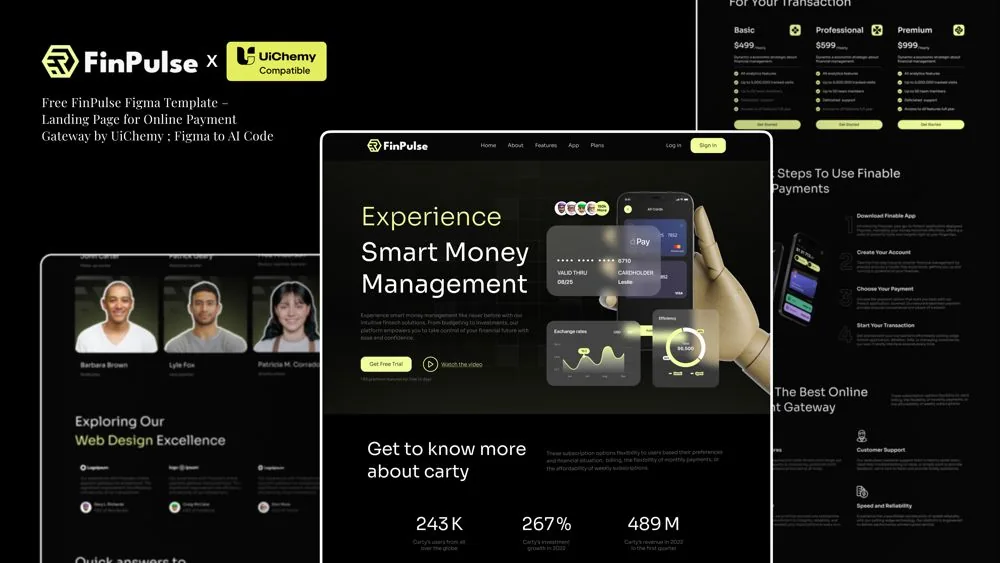
Pre-taggedFinPulse

FinPulse

Fintech and payments landing page

View on Figma
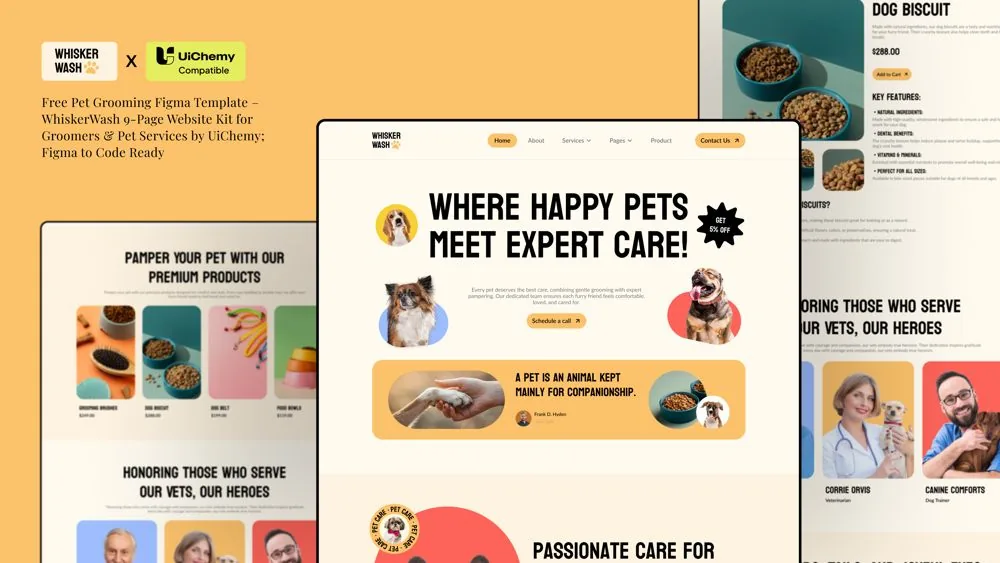
Pre-taggedWhiskerWash

WhiskerWash

Pet grooming website kit

View on Figma
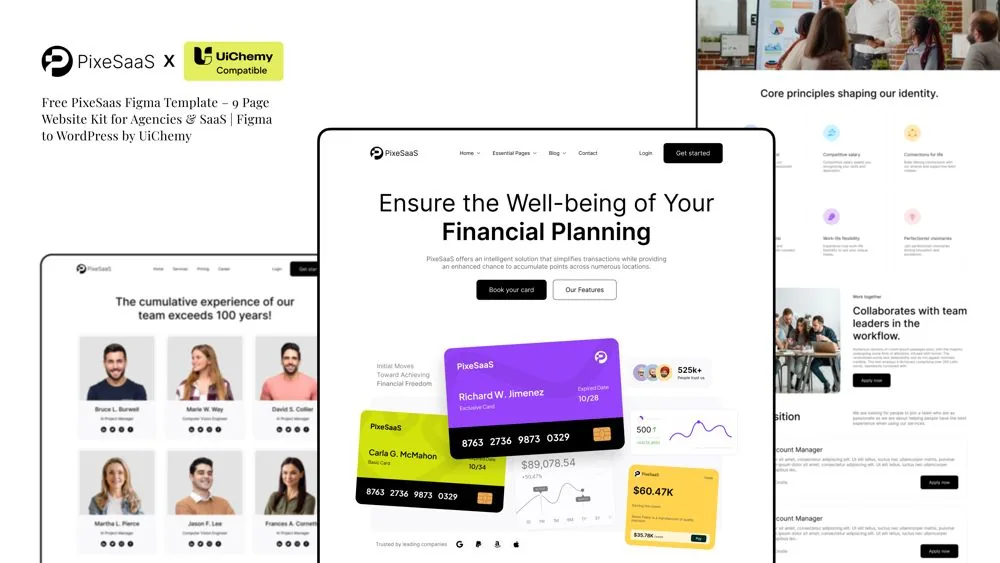
Pre-taggedPixeSaaS

PixeSaaS

9-page SaaS website kit

View on Figma
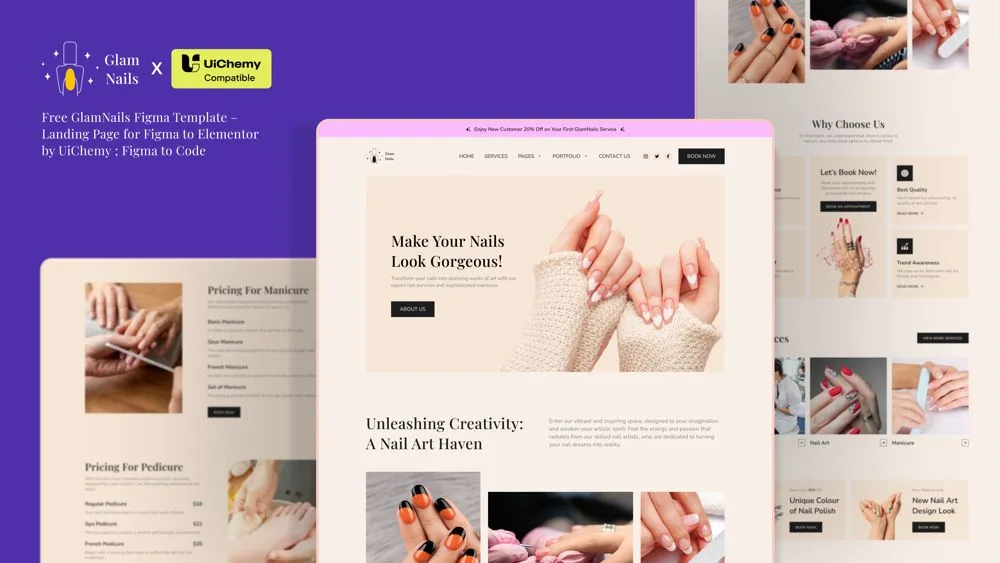
Pre-taggedGlamNails

GlamNails

Nail studio landing page

View on Figma
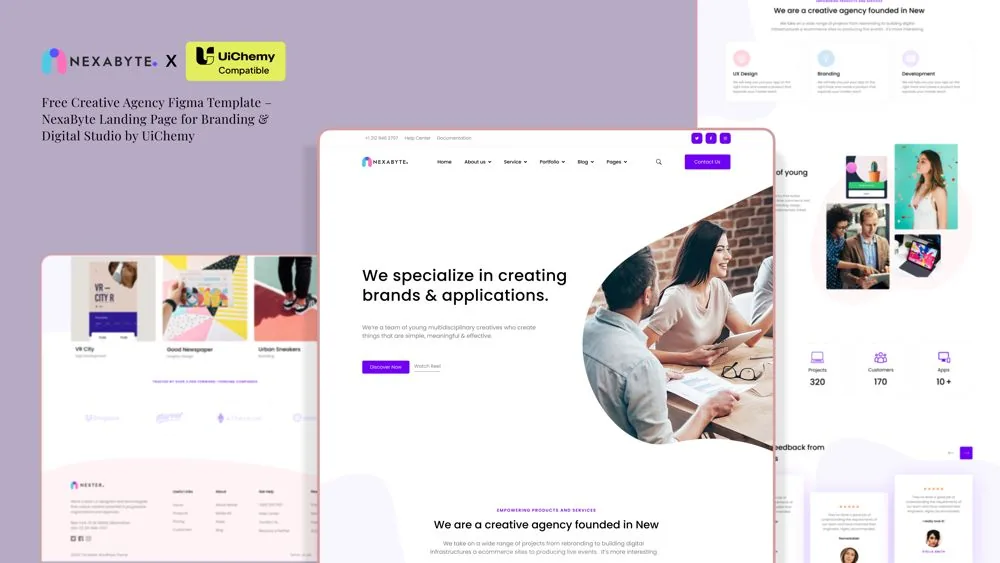
Pre-taggedNexaByte

NexaByte

Creative agency landing page

View on Figma
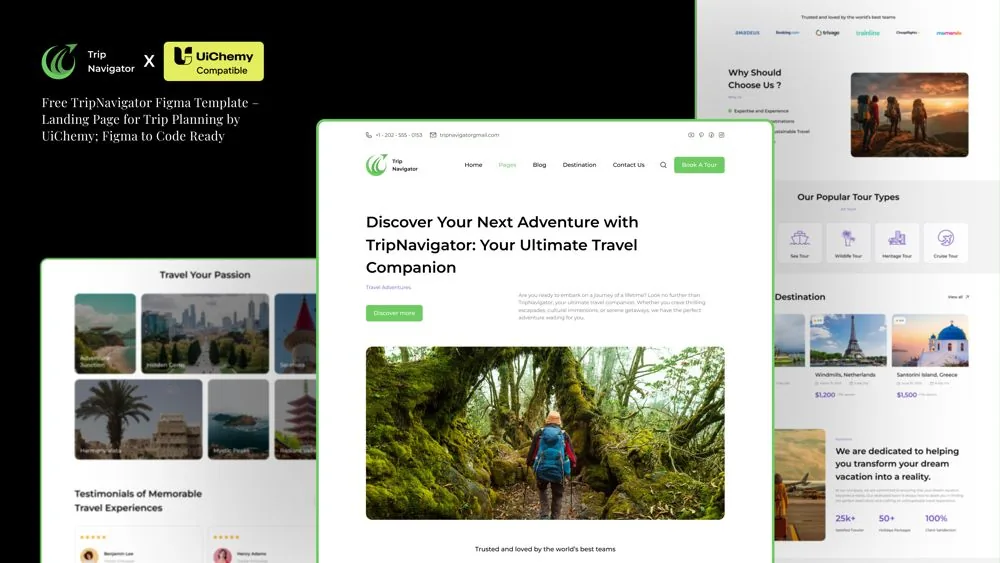
Pre-taggedTripNavigator

TripNavigator

Travel planning landing page

View on Figma

Loved by designers

90,000+ Designers Rate Us 4.9 Out Of 5

90,000+ working Figma designers convert with us instead of rebuilding by hand, and rate it 4.9 out of 5.

FAQ

Classic Mode Questions, Answered

Still have a question?Chat with AI

Classic is the manual path: you tag every layer and set each breakpoint yourself, for pixel-exact control. AI Express does the mapping automatically for speed. Same plugin, and Classic costs far fewer Credits.

Full control. You choose which widget or block every layer becomes, set auto layout, and tune responsive behavior per breakpoint before you convert. Nothing is decided for you.

Because you map the layers by hand, the output matches your Figma frame closely on every builder. Any final tweak happens on native widgets you fully own, so nothing is locked.

Yes. You get native builder widgets and blocks, not exported code or a flat image, so you keep editing in Elementor, Gutenberg, or Bricks exactly as normal.

Yes. UiChemy turns your Figma file into a live, editable WordPress page. Tag your layers, map them to native widgets, and convert with pixel-level control.

Native, editable builder widgets you fully own, not exported code and not a flat image. Everything stays editable after conversion.

Cleaner designs convert better. Use auto optimization for a quick pass, or the manual steps to structure with auto layout and a clean hierarchy.

Yes. Sprout UI and 11 free, pre-tagged designs are published on the Figma community, all built and optimized for a clean UiChemy conversion.

It still converts. UiChemy handles non-auto-layout frames, and manual optimization walks you through adding structure so the result stays clean and responsive.

You generate one Connection Link in your UiChemy dashboard and paste it into the Figma plugin. That is the whole setup.

Yes on most WordPress hosts. If a security plugin like Wordfence, or a managed host, blocks the connection, our docs show the one setting to allow it and support will get you connected.

Yes. Local and staging sites connect the same way, with a Connection Link.

Almost none. Classic spends only a small amount per conversion, so you can iterate and re-convert freely. Your Credit pool refills every month.

One unit per conversion. AI Express costs more Credits, Classic almost nothing, and your pool refills every month.

No. Credits are spent on completed conversions, so a failed attempt does not drain your balance.

Yes. A seat is one Figma account or one WordPress site, so Designer covers 2, Studio 10, and Agency 50.

Elementor v3 and v4, Bricks, and Gutenberg, plus Nexter, GenerateBlocks, Spectra, and Kadence blocks, all from one plugin and one Figma file.

Yes. UiChemy brings your Figma color, type, and spacing into your builder's global styles as reusable classes, so the whole page stays on-system.

Elementor (Classic and the new v4 Atomic), Gutenberg, and Bricks, plus block libraries like Nexter Blocks, GenerateBlocks, Spectra, and Kadence, all from one plugin.

Yes. UiChemy syncs your Figma colors and typography into your builder's global styles as reusable classes.

Yes, both are covered, and non-auto-layout designs convert too.