
How to Quote AI-Built Websites for Clients Without Underpricing Yourself
 Sagar Patel

Quote AI-built websites by the outcome and the responsibility you carry, not the hours of generation. Price the scope, the review, the accountability and the ongoing care, then list tool costs separately. Faster delivery is a margin, and the client is buying a result they can rely on.
This is a framework, not a set of market rates. We have no case data on what agencies charge, so we give you a method and leave the numbers to you. For the surrounding workflow, see AI workflows for WordPress agencies. For how the tools compare, see best AI website builder: what the roundups miss.
The Hourly Trap
If you charge by the hour and AI cuts a build from days to hours, your invoice shrinks by the same amount. You did the work better and faster, and you earned less for it. That is the trap.
The fix is to stop selling time. A client with a deadline and a goal does not care whether the first draft took two minutes or two days. They care that the site is correct, on brand, editable and live. Those outcomes are what you price.
This is also why the comparison in AI website generator vs hiring a freelancer matters: the client can try a generator themselves, so your quote has to cover what a generator does not give them.
What the Client Is Actually Buying
- Judgement. Choosing the right pages, copy and structure for their business.
- Accuracy. Catching what AI gets wrong, such as invented claims and wrong counts. Our test showed three requested cards turning into five, which no client wants to find after launch.
- Accountability. One person who answers for the result.
- Handoff. A site the client can edit and keep running.
- Time saved for them. They avoid learning tools and managing revisions.
None of this goes away when generation gets cheap. The review you run is the product. The post on reviewing an AI-generated WordPress site in 30 minutes is a good picture of what that work involves.
Building the Price From Parts
Break the quote into parts the client can understand, then decide a price for each. This is a structure, with no numbers attached on purpose.
| Part | What it covers | How to price it |
|---|---|---|
| Discovery and brief | Questions, goals, page list, sign-off | Fixed fee per project |
| Structure and content | Sitemap, copy direction, content review | Per page or per package |
| Build | Generation, edits, brand, forms | Package, not hours |
| Review and QA | Counts, claims, mobile, speed, accessibility | Fixed, included in the package |
| Handoff and training | Client role, edit guide, short session | Fixed fee |
| Care plan | Updates, backups, small edits | Monthly retainer |
| Tools and hosting | Credits, plans, domain, hosting | Pass through or fold in, but list it |
Offering two or three packages with different page counts gives clients a choice, and makes the decision about which tier, not whether to hire you. The page count guide helps you define the tiers.
Your Real Costs With AI Tools
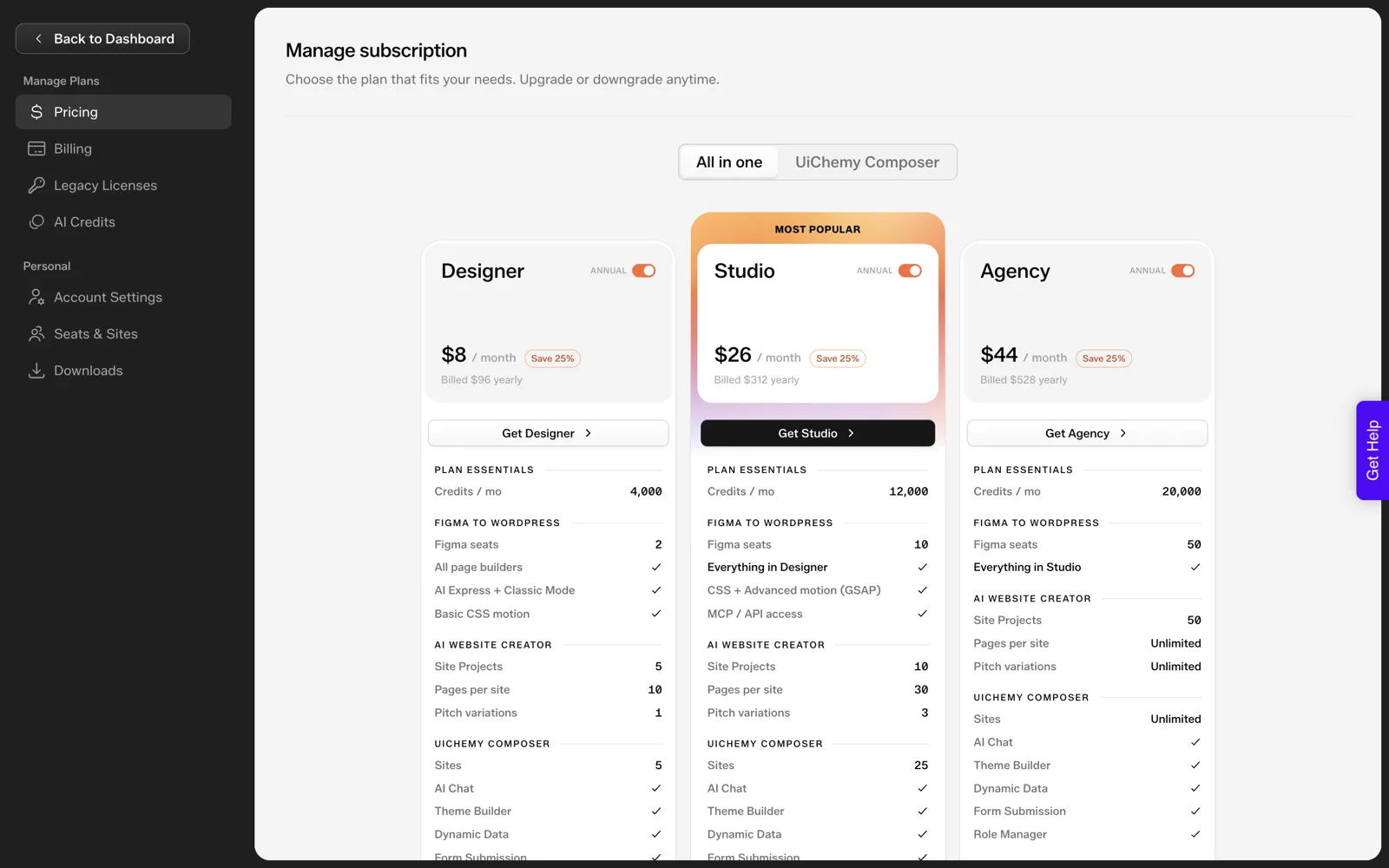
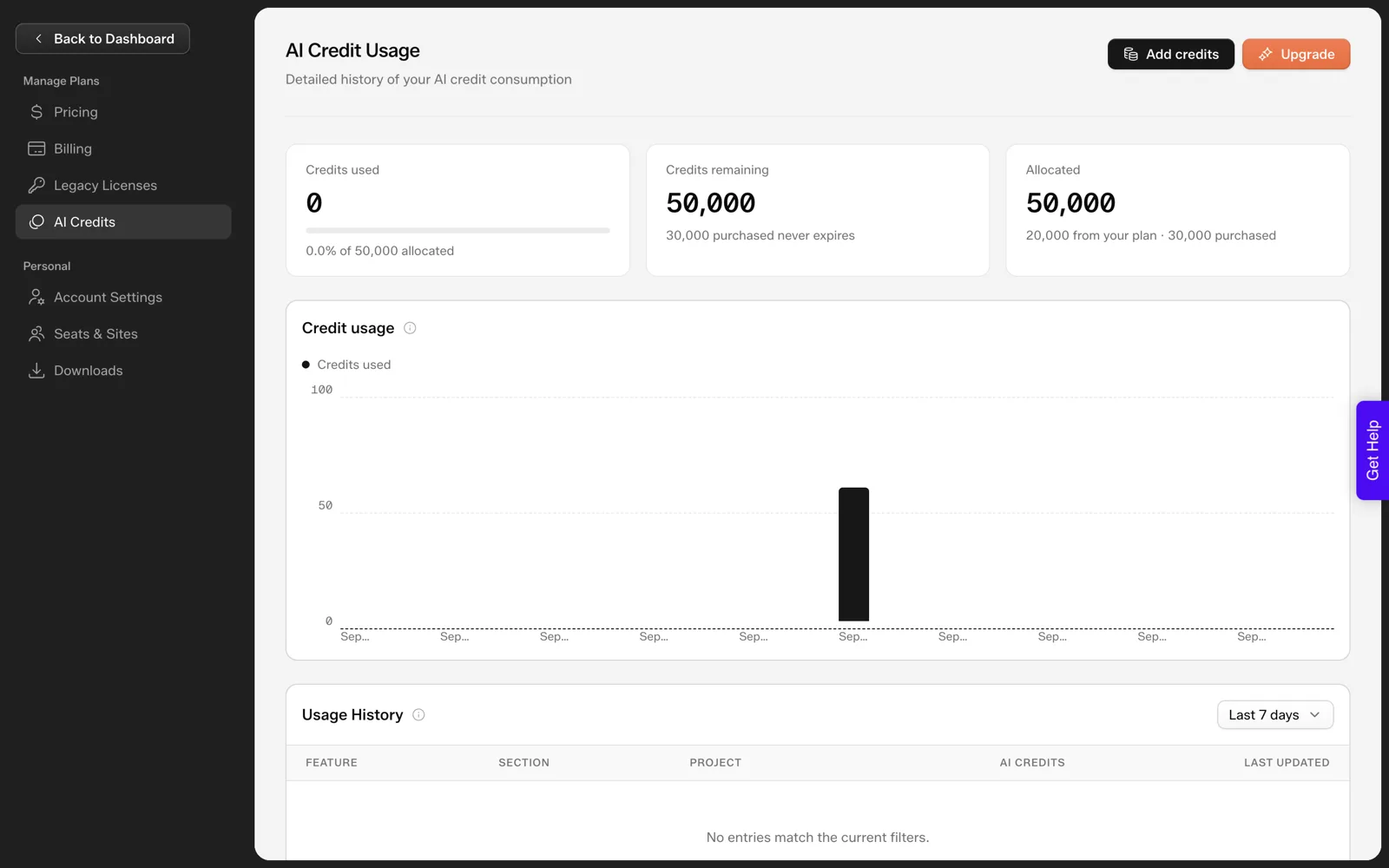
Know your costs so that you do not underprice by accident. With UiChemy, the all-in-one plans are credit based: Designer at $11 a month with 4,000 credits, Studio at $35 with 12,000 and Agency at $59 with 20,000, cheaper when billed annually.
In our one measured run, a sitemap plus a Home page used about 64 credits. That is one data point, so measure your own typical project.
The AI credits documentation explains how credits are counted. Tool cost is likely to be a small part of the total. Your costs also include your review time, hosting, support and the unbillable hours that creep in. The post on how many credits an AI-built website costs shows how we measured, and UiChemy pricing explained has the plan detail.
Protecting the Quote
AI makes it easy to say yes to small changes, so scope creep arrives faster. Protect the price with three habits.
- Write down the page list and exclusions before design. The scope creep guide has a sign-off clause and a change request form to copy.
- Limit revision rounds. State how many rounds are included and what counts as a round.
- Price changes, do not absorb them. A change request keeps the conversation friendly and the project profitable.
Start the project with a proper brief, using the website brief template and the client questionnaire, so the quote rests on answers and not guesses.
A Quote Template to Copy
WEBSITE QUOTE

Client: ____________   Project: ____________   Date: ______
Valid for: 14 days

THE GOAL
[One sentence: what this site must achieve for the client]

OPTION A: [name]   Price: ______
  Pages: [list]
  Includes: brief and sign-off, structure, build, review and QA,
  handoff session, [N] rounds of revisions
OPTION B: [name]   Price: ______
  Everything in A plus: [extra pages or features]
OPTION C: [name]   Price: ______
  Everything in B plus: [extra pages or features]

CARE PLAN (optional)   Price per month: ______
  Updates, backups, small edits up to [N] per month

NOT INCLUDED
  Pages outside the list, additional languages, store, booking,
  photography, copywriting beyond supplied text

TOOLS AND HOSTING
  [included in price / billed at cost: ______]

PAYMENT
  [deposit] to start, [balance] on launch

CHANGES
  Anything outside this scope is a change request, priced before work begins.

Accepted by: ____________   Date: ______
Talking About AI With the Client
Be honest and unashamed. Say that you use AI tools for the first draft and that your work is deciding what to build, checking it and standing behind it. Clients rarely object to speed, and they do object to surprises, so tell them what you use and why.
If a client asks for a discount because “AI does it”, return to the parts table, and show them what each line buys. The draft is one line of the quote. Review, accountability and care make up the rest. For comparisons with other routes, AI website builder for agencies covers how to run many client sites without chaos.
A Worked Example: Turning One Brief Into a Quote
Here is how I would walk one project through the parts table. The client, the page list and every figure are placeholders, because we have no data on what any market pays. Swap in your own numbers.
The client is a local business that wants a five-page site. You agree the page list first, then price each part on its own line.
| Line | What the client sees | Your price |
|---|---|---|
| Discovery and brief | One call, a written brief, a signed page list | [YOUR FIGURE] |
| Build, five pages | Structure, content direction, build, brand applied | [YOUR FIGURE] |
| Review and QA | Counts, claims, mobile and speed checks | Included in the build line |
| Handoff session | A short call and a written edit guide | [YOUR FIGURE] |
| Tools and hosting | Plan, domain and hosting, listed at cost | [YOUR FIGURE] |
| Care plan (optional) | Monthly updates and small edits | [YOUR FIGURE] per month |
Notice that no line says “AI”. The client does not need a line for the tool. They need to see what each part gets them, and the review line shows that someone checks the work.
Handling Pushback on the Price
Clients push back in a few predictable ways. Answer each one with the table, not with an apology.
| What the client says | What is usually behind it | A plain reply |
|---|---|---|
| “Can’t AI just do this for free?” | They have seen a generator demo | “A generator gives a draft. You are paying for the checking, the fit to your business and someone who answers for the result.” |
| “This should take an hour.” | They are thinking in time, not outcome | “The draft is quick. Discovery, review and handoff are what make it safe to launch.” |
| “Can you drop the review line?” | They see it as optional | “The review is how we catch wrong counts and invented claims before your customers do.” |
| “Another agency quoted less.” | A different scope, not always a different price | “Let’s compare page lists, revision rounds and what happens after launch.” |
| “Can we add a few things?” | Small changes feel free with AI | “Yes, as a change request. I will send the cost before I start.” |
If the client still wants less, cut scope and keep the rate. Fewer pages or a shorter care plan is a fair trade. A lower price for the same work teaches the client that your number is negotiable.
Scoping the Care Plan
The monthly plan is where the margin from fast builds becomes steady income. It needs a clear edge, or it turns into unpaid work.
- List what is included. Updates, backups and a set number of small edits per month.
- Define a small edit. For example, text or image swaps on existing pages. New pages are a new quote.
- State a response time. Say when the client can expect a reply, in your own terms.
- Say what is excluded. New features, redesigns and anything that needs a fresh brief.
- Set a review date. Revisit the plan after a few months and adjust it.
Pick numbers you can keep. A plan you cannot deliver costs you more than no plan. For a view of how agencies handle many such plans at once, read an AI website builder for agencies.
When you are unsure whether a project suits this model at all, the when not to use UiChemy post lists the cases where I would pick another route.
Reviewing Your Quotes After Three Projects
Your first quotes will be guesses. After three real projects, compare each quote with what the work took, then adjust. Look at which line ran over, which clients asked for the most changes and which care plans were used.
Keep a simple record: the quote, the actual effort, the changes requested and whether the client stayed on a care plan. A pattern shows up quickly. If review always runs long, raise that line. If handoff is never used, fold it into the build.
Use your own data here, not ours, since we have none to offer on agency pricing.
FAQ
Should I charge less for AI-built websites?
Not by default. Price the outcome, the review, the accountability and the ongoing care. If generation saves you time, that improves your margin or lets you serve more clients. Discount only when the scope really shrinks, such as fewer pages or less support.
Should I tell clients I use AI?
Yes. Be plain about it, and describe what you add: judgement, checking, brand fit and handoff. Many clients care about speed and result. Hidden use creates trust problems if they discover it later, while open use is easy to defend and costs you nothing.
How do I price tool costs like credits and plans?
Either fold them into the package price or list them as a pass-through at cost. In both cases, know your own numbers. Measure the credits a typical project uses on your plan, so that you are quoting from data and from nothing else.
How do I stop scope creep on AI projects?
Agree the page list and exclusions in writing before design, limit revision rounds and price every change as a request. AI makes small changes feel free to make, so the written scope matters more than it did before, and the sign-off should cover it.
Is hourly or fixed-price better for AI-built sites?
Fixed-price packages usually suit AI-assisted work better, since your speed becomes margin instead of lost revenue. Use hourly rates only for open-ended work where scope cannot be defined, and keep a monthly retainer for ongoing care after launch. That mix protects your income when the build itself is quick.
To see how a draft comes together for your own client brief, you can Get Started and try a short prompt.
Every feature named in this post is listed by product: all UiChemy features, AI to WordPress features.